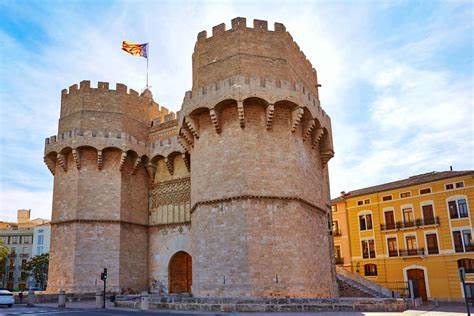
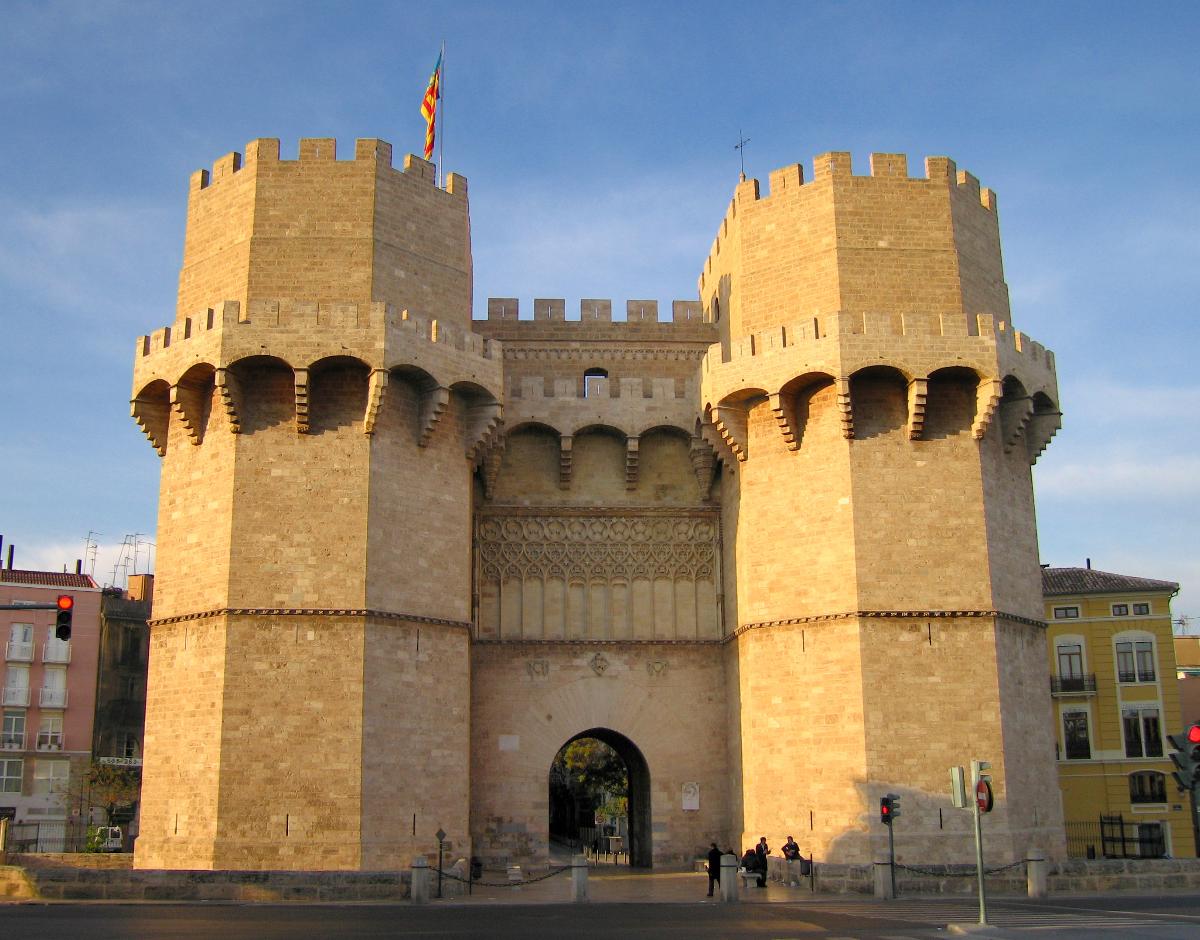
The Torres de Serranos (Serranos Towers) stand as one of Valencia’s most iconic landmarks and a testament to its medieval past. Erected between 1392 and 1398 under the direction of architect Pere Balaguer, these imposing Gothic towers once served as the principal northern gateway into the walled city.
Historical Significance
Originally constructed for defensive purposes, the towers also played ceremonial roles, welcoming ambassadors and royalty into Valencia. In 1586, following a fire that destroyed the city’s main prison, the towers were repurposed as a detention center for nobles and knights, a function they served until 1887.
During the Spanish Civil War, the robust structure of the Torres de Serranos was utilized to safeguard invaluable artworks from the Prado Museum in Madrid. To protect these treasures from potential bombings, the towers were reinforced with layers of concrete, rice husks, and soil, and equipped with humidity and temperature control systems.
What to Expect
Visitors can ascend the towers to enjoy panoramic views of Valencia, including the historic city center and the Turia Gardens. The interior showcases Gothic architectural elements, such as vaulted chambers and stone staircases. The towers also play a pivotal role in local festivities; notably, they serve as the backdrop for “La Crida,” the opening ceremony of the Fallas festival, where the Fallera Mayor invites citizens to partake in the celebrations.
Located at the edge of Valencia’s old town, the Torres de Serranos are easily accessible and offer a glimpse into the city’s rich history and architectural heritage.
Architectural Significance
The towers feature a polygonal design, flanking a central archway that served as the main entrance to Valencia. Built primarily for defensive purposes, their robust stone construction was later clad in limestone from Alginet to enhance their grandeur.
Historical Uses
- Ceremonial Gateway: Beyond defense, the towers were used for official ceremonies, welcoming ambassadors and royalty into the city.
- Prison for Nobility: Following a fire in 1586 that destroyed Valencia’s main prison, the towers were repurposed to detain nobles and knights until 1887.
- Art Storage During Civil War: During the Spanish Civil War, the towers safeguarded artworks from Madrid’s Prado Museum. To protect these treasures, the structure was reinforced with layers of concrete, rice husks, and soil, and equipped with humidity and temperature control systems.
Modern-Day Highlights
- Panoramic Views: Visitors can ascend the towers to enjoy sweeping views of Valencia, including the historic city center and the Turia Gardens.
- Cultural Events: The towers play a pivotal role in local festivities; notably, they serve as the backdrop for “La Crida,” the opening ceremony of the Fallas festival, where the Fallera Mayor invites citizens to partake in the celebrations.
 Valencia Cathedral
 Plaza De Toros
 Gulliver Park – A Giant Playground Adventure in the Heart of Valencia
 Oceanogràfic